Betaflight Blackbox Setup: Record a Log You Can Actually Diagnose
Blackbox records the gyro, sticks and setpoint, PID terms, motors, RPM, voltage and current. But a log on out-of-the-box settings often shows very little. Real examples from logs we've analysed: a 3.5-inch on Betaflight 4.5.2 logging at 1 kHz while its motors spin up to 644 Hz; a Betaflight 2026.6 log at 247 Hz with no raw gyro and no RPM; a 7-inch on 4.6 logging 2 kHz to an SD card with 182 gaps; an INAV 7.1 log at 58 Hz that says nothing about vibration.
What each check needs
Thresholds come straight from the analyzer's code; below them a check stays silent or flags too little data.
| Check | Log fields | Logging rate | What to fly |
|---|---|---|---|
| Per-motor vibration: which motor or prop shakes | unfiltered gyro + eRPM | ~250 Hz+; works even above Nyquist | half a minute of steady flight at varied throttle |
| Noise, filters, frame resonances | unfiltered and filtered gyro | 500 Hz+; exact resonance frequency at 1/1 (or 2 kHz+ for resonances below 500 Hz) | hover plus a slow throttle sweep to 100% |
| Motor noise and which PID term carries it | motor, axisP, axisD, axisF | 500 Hz+ | any flight |
| Step response and latency | setpoint + gyro | 200 Hz+ | Acro; 10+ usable one-second windows with the stick at 20 deg/s or more, 50 for a “critical” verdict |
| Propwash | setpoint, throttle | 200 Hz+ | 3 clean chops minimum, 5 for a confident verdict |
| Bounce-back after flips | setpoint, axisP/I/D/F | 200 Hz+ | 6+ sharp stick stops per axis |
| Punch-out dip (anti-gravity) | setpoint, throttle, axisI | 100 Hz+ | 6+ punch-outs with the other sticks centred |
| Battery sag and resistance | vbat; a current sensor too for resistance | any | for resistance, 5+ one-second windows with an 8 A+ current swing |
| Crash analysis | accelerometer, gyro, RSSI/failsafe, eRPM, vbat | any | — |
Under 10 seconds in the air, every tuning finding is downgraded to “info” and loses its CLI commands, and bounce-back and punch-outs aren't measured. If over half the flight was in Angle or Horizon, step response and bounce-back are skipped: there the stick commands an angle, not a rotation rate.
Logging rate and aliasing
Why 1 kHz misleads on small quads
A log recorded at N Hz only shows vibration up to N/2, the Nyquist frequency. Anything faster doesn't vanish; it mirrors back below that limit. A motor at 644 Hz in a 1000 Hz log shows up at 1000 − 644 = 356 Hz. That leaves a tidy spectral peak where nothing is happening: an easy target for a misplaced notch or filter.
Three logs from a VX3.5 on Betaflight 4.5.2 (4 kHz PID loop, 1/4, so 1 kHz) had the motors peaking at 583, 605 and 644 Hz, above 500 Hz every time. The figure shows the same effect on another quad: a 2 kHz log with every fourth frame kept, exactly what blackbox_sample_rate does, skipping frames with no filtering first.
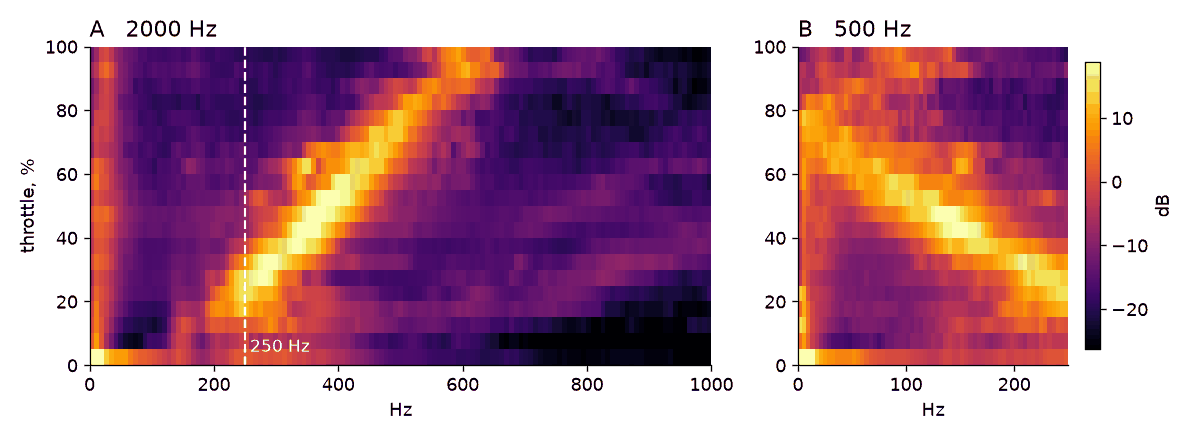
bbdoctor measures per-motor vibration from each motor's rotation phase (eRPM), so it knows where the mirrored copy lands and that check still works at 1 kHz; the noise spectrum and resonances can't be rescued. When peak RPM in a Betaflight log goes above 95% of the Nyquist frequency, the report adds “Logging rate is below the motor frequency” with the right divider as a command.
Picking blackbox_sample_rate
From 4.3 on, the rate is a divider of the PID loop: 1/1, 1/2, 1/4, 1/8 or 1/16, with 1/4 as the default. bbdoctor picks the largest divider that still leaves at least 2 kHz:
| PID loop | Default (1/4) | Set | Result |
|---|---|---|---|
| 8 kHz | 2 kHz | 1/4 | 2 kHz |
| 4 kHz | 1 kHz | 1/2 | 2 kHz |
| 3.2 kHz (BMI270) | 800 Hz | 1/1 | 3.2 kHz |
Your loop rate is on the Configuration tab. Not every build needs 2 kHz: bbdoctor only asks once the motors outrun the logging rate. A 7-inch 6S in our set never went past 315 Hz, so 1 kHz would have done. A 3 to 3.5 inch on 4S at 1 kHz usually goes over, and not only those: in four 1 kHz logs from a 6S quad on 4.5.1 the motors reached 529–554 Hz. On a BMI270, 1/1 eats flash fastest; if space is tight, 1/2 (1.6 kHz) still covers motors up to about 760 Hz. 1/8 and 1/16 are useless for analysis (500 and 250 Hz on a 4 kHz loop), and the config check flags them.
Flash budget
File sizes in our set: at 1 kHz with all fields, about 34 KB/s without debug fields and 41–43 KB/s with a debug mode on; at 2 kHz, 58–70 KB/s. An 8 MB flash lasts about 3 to 4 minutes at 1 kHz and 2 minutes at 2 kHz. That VX3.5 (debug_mode = GYRO_SCALED) filled its 8 MB to the last byte in 195 seconds at 1 kHz and stopped mid-flight. bbdoctor spots this (a cut-off end, or a file of exactly 2, 4, 8 or 16 MB) and warns alongside the rate advice that recording time will halve.
So erase the flash before testing (Erase flash on the Blackbox tab, or flash_erase in the CLI), fly 1–2 minute test packs and drop fields you don't need. An SD card has room, but a slow one drops frames: the 7-inch on 4.6 logging 2 kHz to SD had 182 gaps. Use a decent, freshly formatted card; if gaps persist, step the rate down.
Betaflight settings by version
4.5 and 2025.12+
For a 4 kHz PID loop (use 1/4 on 8 kHz and 1/1 on 3.2 kHz):
set blackbox_mode = NORMAL
set blackbox_sample_rate = 1/2
set blackbox_disable_gyrounfilt = OFF
set blackbox_disable_rpm = OFF
set blackbox_disable_setpoint = OFF
set blackbox_disable_pids = OFF
set blackbox_disable_motors = OFF
set debug_mode = NONE
saveblackbox_deviceis left out so the paste can't break SD logging. Check it yourself:SPIFLASHfor onboard flash,SDCARDfor a microSD slot,NONErecords nothing.blackbox_mode = NORMALrecords from arm to disarm; with a BLACKBOX mode assigned on the Modes tab, only while that switch is on.- Raw gyro and RPM have their own fields here, so no debug mode is needed; with
debug_mode = NONEno debug fields are written. - The RPM field only exists with bidirectional DShot on (see below).
A Betaflight 2026.6.1 log was recorded at 1/16 (247 Hz on a 4 kHz loop) with raw gyro and RPM off, though bidirectional DShot was running. The report gave both commands to turn them back on. A 4.5.1 log had setpoint off: bbdoctor rebuilds it from sticks and rates, with a rougher PID estimate, and says so.
4.3–4.4
set blackbox_sample_rate = 1/2
set debug_mode = GYRO_SCALED
save
Pick the divider from the table above. There are no unfiltered gyro or RPM fields yet. The gyro goes through debug, and only one debug mode runs at a time, so DSHOT_RPM_TELEMETRY is out (bbdoctor doesn't read RPM from debug anyway). Even with bidirectional DShot working it recommends 4.5, since without RPM it can't name the unbalanced motor. The blackbox_disable_… settings exist from 4.3 (rpm and gyrounfilt from 4.5): check that setpoint isn't off.
4.0–4.2
set blackbox_p_ratio = 64
set debug_mode = GYRO_SCALED
save
These versions use blackbox_p_ratio. The rate is roughly p_ratio × 31.25 Hz: 32 gives about 1 kHz, 64 about 2 kHz, capped at the PID loop rate. A 4.2.11 log in our set was recorded at just 534 Hz and had 36 gaps on top.
Fields you can switch off, and ones you can't
blackbox_disable_gps, blackbox_disable_mag and blackbox_disable_alt (baro) are safe to turn ON unless you analyse navigation. Keep:
- gyro and motors: a log without the gyro or motor commands isn't accepted at all;
- setpoint and pids: needed for an accurate step response and to split bounce-back into P, I, D and FF;
- rc: gives the stick-smoothing delay (rcCommand → setpoint) and rebuilds the setpoint if that field is off;
- acc: impacts in crash analysis;
- bat: voltage sag, battery resistance, power loss as a crash cause;
- rssi, if RSSI is set up: link loss before a crash.
RPM in the log
RPM comes from bidirectional DShot: set dshot_bidir = ON, save, with the DShot protocol and ESCs on Bluejay, AM32 or BLHeli_32. Then take the props off, spin the motors with the sliders on the Motors tab and check that RPM shows up with errors near zero. Check motor_poles too: motor frequency is computed from eRPM through the pole count. Most 5-inch motors have 14 poles, some small ones 12; get it wrong and every motor frequency in the log is off. More in the RPM filter and bidirectional DShot guide.
INAV
set blackbox_rate_num = 1
set blackbox_rate_denom = 2
blackbox GYRO_RAW
blackbox MOTORS
save
In INAV the logging rate is the fraction blackbox_rate_num/blackbox_rate_denom of loop cycles. INAV 8 and later default to a 2 kHz loop (looptime = 500), where 1/2 gives 1 kHz; INAV 7 and earlier default to 1 kHz (looptime = 1000), where 1/2 gives 500 Hz. Vibration and filter checks need 500 Hz or more. Three INAV 7.1.2 logs in our set, from a 7-inch and a 5-inch, were recorded at 1/32, or 58–60 Hz: all they can show is motor balance and the battery. An INAV 8.0 log at 1/2 came in at 995 Hz, with noise and filters plain to see.
blackbox GYRO_RAWadds the raw gyro,blackbox MOTORSthe motor commands. Two INAV 7 logs with MOTORS off were rejected outright.- INAV doesn't log per-motor RPM, so per-motor vibration isn't available.
- An INAV 8.0 log flown 78% in Angle/Horizon got no PID verdict.
- An INAV 6.1 log had 27% corrupted frames. bbdoctor drops them and flags its PID and noise findings as unreliable; re-fly a log like that.
Details are in the INAV blackbox guide.
ArduPilot and PX4 in brief
ArduPilot. Without the fast bits in LOG_BITMASK (the default has none), ArduCopter logs the gyro at 25 Hz, as in all ten ArduCopter logs in our set, 4.1 to 4.8-dev. For analysis, set bit 0 (ATTITUDE_FAST) and bit 19 (IMU_RAW) in LOG_BITMASK, plus INS_RAW_LOG_OPT = 9 on 4.5+ for the gyro before and after filtering. RPM comes from ESC telemetry or bidirectional DShot (SERVO_BLH_BDMASK). Use the .bin from the SD card (APM/LOGS), not a .tlog. For ArduCopter PIDs the built-in AUTOTUNE is more reliable; the log is for vibration and filters. See the ArduPilot log analysis guide.
PX4. Add bits 4 (High rate) and 8 (Raw FIFO gyro) to SDLOG_PROFILE: from the default of 1 that's 273, or param set SDLOG_PROFILE 273 in the QGroundControl MAVLink Console, then reboot: the profile is read at startup. The .ulg is under Analyze Tools → Log Download. See the PX4 ULog guide.
The test flight
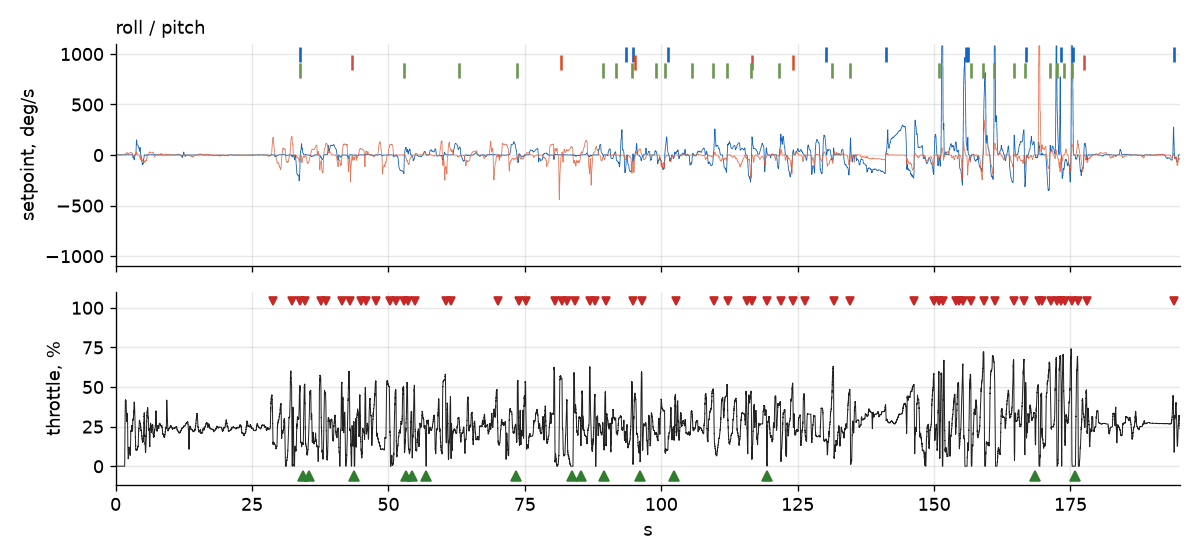
Freestyle hits these events by chance; a 1.5–2 minute test pack collects 6–8 of each on purpose:
- Before takeoff. Fresh props, a charged pack, erased flash, BLACKBOX switch on if you use one.
- Acro mode. Angle and Horizon rule out step response and bounce-back.
- 30 seconds of hover and smooth cruising, then, if there's room, a slow 5-second throttle roll from hover to 100% for the noise-versus-throttle map.
- 6–8 flips or rolls per axis, plus yaw spins. Snap the stick back to centre in under 0.2 s and hold it there for half a second. Moves count from 150 deg/s on roll and pitch and 120 deg/s on yaw; a slow return to centre is thrown out.
- 6–8 punch-outs from hover (about 30% throttle, always below 70%): more than a quarter of throttle travel in 0.2 s. Don't touch roll and pitch; above 80 deg/s of setpoint the punch doesn't count.
- 6–8 straight chops: climb, chop to zero, sticks centred for about a second. A chop counts if throttle was above 35% and fell by more than 25% within 0.15 s. No flips straight after: in one 2 kHz log, 12 of 15 chops went straight into a flip or roll, leaving 3 usable for propwash.
- Landing. Land gently, without a chop just above the ground: a chop that ends in an impact is left out of the propwash check.
A big rig doesn't need flips; short, sharp stick tilts at a safe height will do. Length alone guarantees nothing: five minutes of ordinary flying on a 7-inch gave 5 chops (one clean), 1 punch-out and 1 sharp roll stop.
Getting the log off
In Betaflight and INAV, use Save flash to file on the Blackbox tab, or Mass Storage mode so the board mounts as a drive. With an SD card, copy the file. INAV files often end in .TXT, ArduPilot uses .bin, PX4 .ulg.
One file can hold many flights, one per arm; our set includes a Betaflight 2026.6 file with 66. bbdoctor takes the longest by default (number 58 there), and the report lets you pick any other.
Common mistakes
| Symptom | Cause | Fix |
|---|---|---|
| Empty log, or no flight in it | BLACKBOX switch off, blackbox_device = NONE, flash already full | check Modes and Blackbox, erase the flash |
| Log stops mid-flight | flash full: the file is exactly 8 or 16 MB | erase before flying, 1–2 minute packs |
| “Gaps in the recording” | slow SD card or too high a rate | a decent card, otherwise one divider step down |
| “The setpoint isn't logged” | blackbox_disable_setpoint = ON | set blackbox_disable_setpoint = OFF |
| No PID verdict | over half the flight in Angle/Horizon | a test pack in Acro |
| INAV log at 60 Hz | large blackbox_rate_denom | 1/2 for the test flight |
| INAV: “no motor commands” | MOTORS field off | blackbox MOTORS |
| No RPM | bidirectional DShot off, Betaflight before 4.5, or blackbox_disable_rpm = ON | enable bidirectional DShot, update, turn the field back on |
| Spectrum peaks no filter change “fixes” | motors faster than ~475 Hz in a 1 kHz log: mirrored frequencies | a divider for ~2 kHz (1/2 on a 4 kHz loop) and a new log |
Check the log automatically
Drop the file into bbdoctor; it's free and needs no account. First it checks the log itself: flight time, gaps and dropped frames, a cut-off end, raw gyro, RPM and setpoint, the logging rate against peak motor frequency, and time in self-level. Anything missing is named, with commands for your firmware version. See the sample report.
You can check the settings before flying: paste your diff all into the config check. It flags blackbox being off, a 1/8 or 1/16 divider, disabled fields, missing GYRO_SCALED on 4.0–4.4, and a low rate or missing GYRO_RAW on INAV. For the finished log, see how to read a blackbox log.
FAQ
What blackbox logging rate should I use?
About 2 kHz: blackbox_sample_rate = 1/4 on an 8 kHz PID loop, 1/2 on 4 kHz and 1/1 on 3.2 kHz (BMI270 gyro). Big quads whose motors stay under about 450 Hz are fine at 1 kHz, but on a 3 to 3.5 inch 4S quad and many 6S builds a 1 kHz log already shows fake peaks in the spectrum.
Why is my blackbox log empty?
Usually the BLACKBOX mode is on a switch that was off, the flash was already full, or blackbox_device is NONE. Check the Modes and Blackbox tabs, erase the flash before the flight and fly for at least 30 to 60 seconds.
Do I need debug_mode on Betaflight 4.5 or 2025.12?
No. Since 4.5 the unfiltered gyro and motor RPM have their own log fields, and with debug_mode = NONE the debug fields aren't written at all. GYRO_SCALED is only needed on 4.0 to 4.4.
How long does onboard flash last at 2 kHz?
In our logs 1 kHz with all fields comes to 34 KB/s without debug fields and 41–43 KB/s with them, and 2 kHz to 58–70 KB/s. An 8 MB flash fills in about 3 to 4 minutes at 1 kHz and about 2 minutes at 2 kHz; 16 MB lasts twice as long.
Updated: